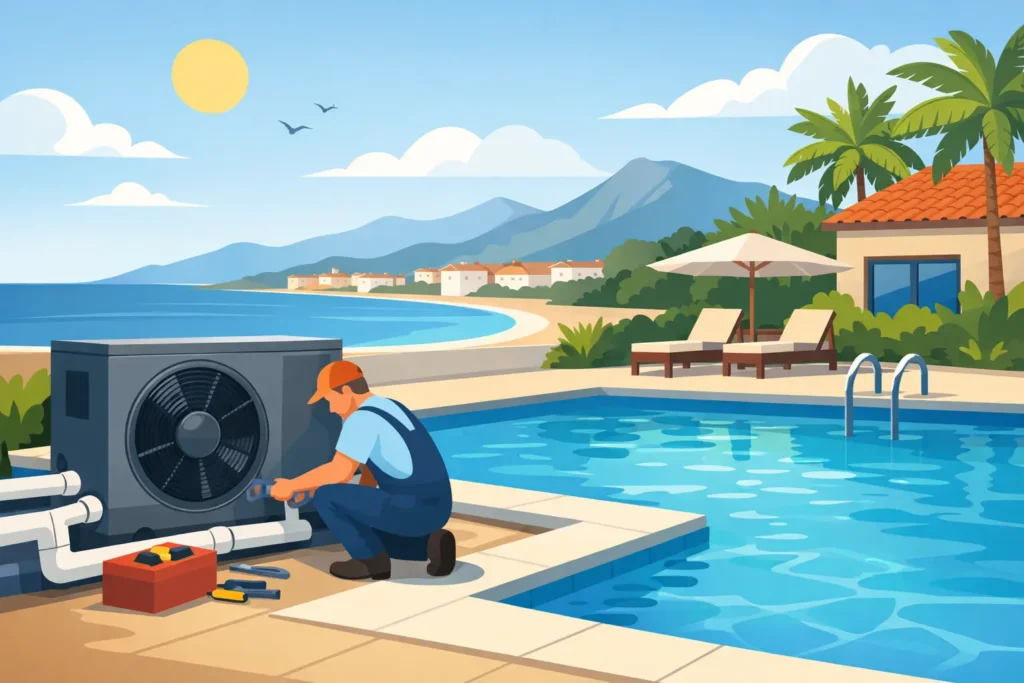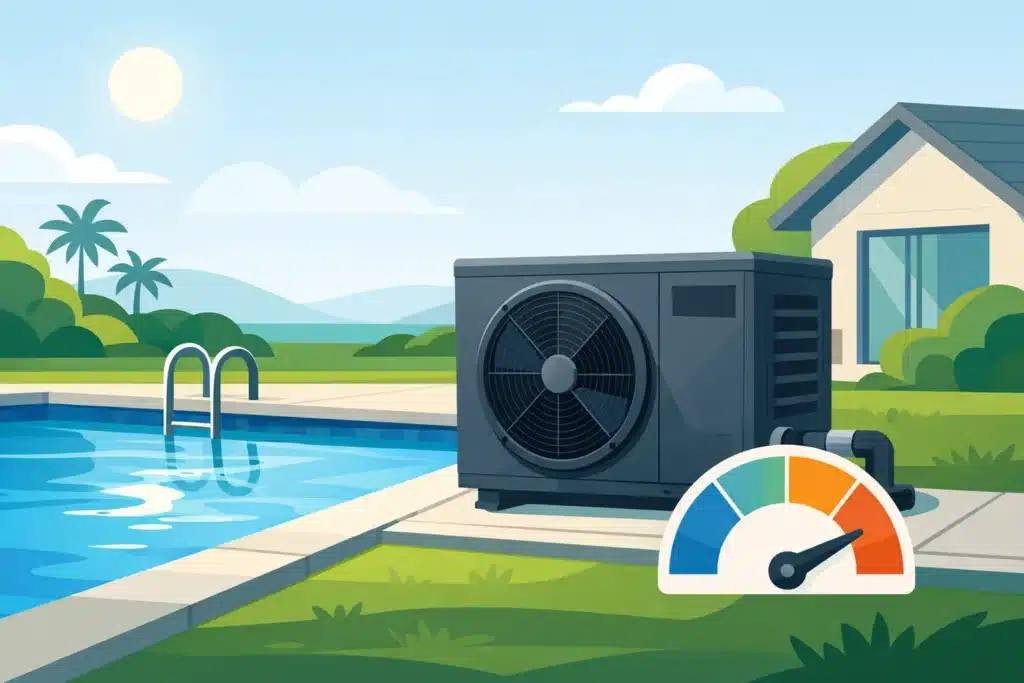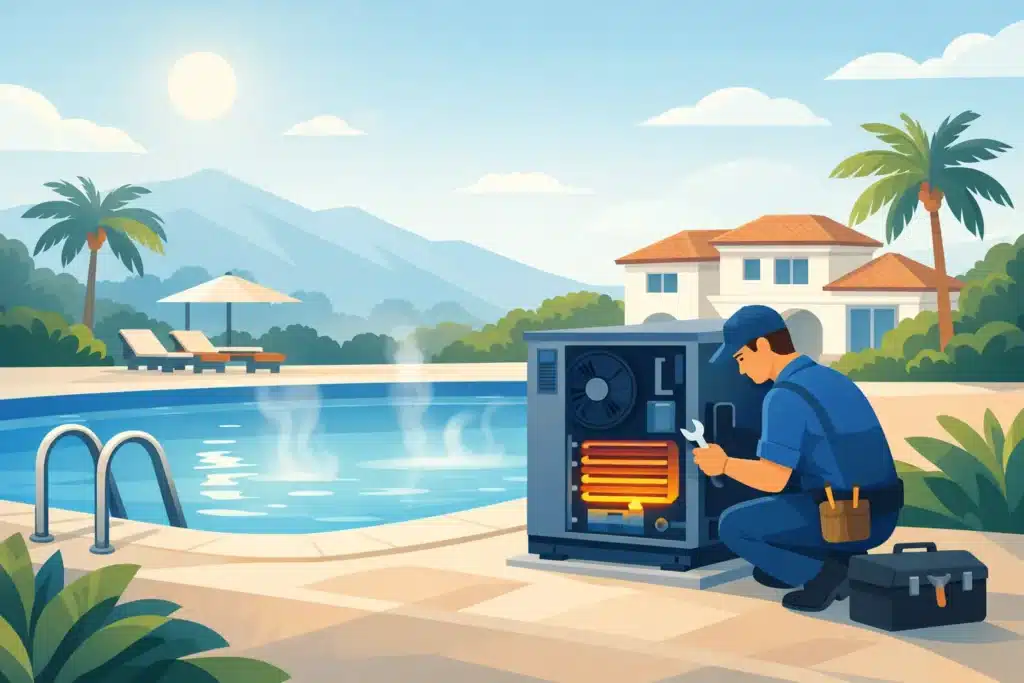
A pool that was comfortably warm last week but struggles to reach temperature now is more than an inconvenience, particularly when family, guests or holiday bookings are involved. Professional pool heater repair Marbella property owners can depend on starts with finding the real cause, rather than simply replacing a part and hoping for the best. Heat pumps, circulation systems, water chemistry and heat loss all affect performance.
On the Costa del Sol, a well-maintained pool heater can extend the useful swimming season significantly. When it develops a fault, prompt, careful attention helps protect both your comfort and your running costs.
When is pool heater repair in Marbella needed?
Some heater faults are obvious. The unit may not switch on, display an error code or trip the electrical supply. Others are less clear: the heater runs for hours with little temperature gain, becomes unusually noisy, or stops and starts without completing a heating cycle.
A gradual loss of performance should not be dismissed as a cold spell. Although outdoor temperature and wind naturally influence a heat pump, a healthy, correctly sized system should operate predictably within its expected conditions. A technician will look beyond the heater itself to establish whether restricted water flow, poor airflow, a failing component or excess heat loss is responsible.
Common signs that deserve an inspection include:
- The pool is taking far longer than usual to warm up.
- The heat pump shows a recurring fault message or repeatedly resets.
- Water flow appears weak, or the circulation pump is making unusual noise.
- The heater runs but blows cold air when it should be recovering heat.
- There is water around the unit, visible corrosion or a noticeable new vibration.
Leaving these symptoms unresolved can turn a relatively straightforward repair into a more expensive call-out. It can also mean the heater consumes electricity while delivering very little useful heat.
The checks that lead to the right repair
Reliable diagnosis is the most valuable part of a pool heater repair. A heat pump is connected to the electrical supply, plumbing and filtration system, so the apparent fault is not always where the fault began.
The first check is usually water circulation. Heat pumps need a consistent flow rate to transfer heat safely. A blocked skimmer basket, dirty filter, closed valve, worn circulation pump or air in the system can all reduce flow enough to trigger protection settings. In many cases, restoring correct circulation resolves the issue without major work to the heater.
Next comes airflow. The fan and evaporator coil need clear space around them. Leaves, dust, garden debris and poor positioning can restrict airflow, particularly after windy weather or a period when the property has been empty. Salt-laden coastal air also makes regular visual checks worthwhile, as it can accelerate surface corrosion on poorly maintained equipment.
Electrical testing is equally important. A qualified technician can assess supply voltage, connections, protective devices and control signals, then identify whether a fault relates to the fan, compressor, sensors, control board or another internal component. Error codes provide useful clues, but they are not a substitute for proper testing.
Finally, the wider heating set-up should be considered. A correctly functioning heater may still seem inadequate if the pool has no cover, the cover is damaged, or the unit was never sized for the pool volume and the way it is used. An exposed infinity pool, for example, loses heat very differently from a sheltered pool with a good solar cover.
Repair, service or replacement: making a sensible decision
Repair is often the right route when the heater is relatively modern, the main components are in good condition and the problem is isolated. Replacing a sensor, capacitor, fan motor, valve, circulation component or control element can restore reliable performance at a sensible cost.
However, repair is not always the most economical long-term choice. Older systems may use more electricity, have limited parts availability or suffer repeated faults. If a major component has failed and the heater has already given many years of service, investing in a more efficient replacement can be the better decision.
This is where transparent advice matters. The useful question is not simply, “Can it be repaired?” It is, “Will this repair give dependable service for a reasonable period, and how does that compare with upgrading?” Property managers may prioritise reliability and guest comfort, while a homeowner with occasional use may make a different choice. Both are valid, provided the options and likely costs are clear.
For suitable upgrades, Eco Pool Heaters supplies and installs premium Norsup electric heat pumps designed for Mediterranean conditions. Their five-year full warranty and ten-year heat-exchanger warranty provide valuable reassurance when replacement is the right answer.
Why heat loss can look like a heater fault
A pool heater does not create a sealed, warm environment. It adds heat to water that is constantly losing energy through evaporation, wind and cooler night-time air. In Marbella, daytime sunshine can be generous while spring and autumn evenings are still cool enough to cause substantial heat loss.
That is why a solar pool cover is one of the most effective partners for a heat pump. It helps retain heat when the pool is not in use, reduces evaporation and limits the amount of reheating required the following day. The result is often a warmer pool with lower operating demand.
If the heater appears to run constantly, a cover assessment should be part of the conversation. The issue may be a technical fault, but it may also be that the system is working hard against avoidable heat loss. A tailored recommendation considers pool dimensions, exposure, desired water temperature, whether the property is occupied year-round and how quickly the pool needs to be ready for use.
Practical care between service visits
Pool owners do not need to become heating engineers, but a few routine checks can prevent avoidable disruption. Keep the area around the outdoor unit clear of leaves, pots and stored furniture so air can circulate freely. Do not use the unit as a shelf or cover it while it is operating.
Maintain regular filtration and cleaning, because poor water flow is a common cause of heater alarms. Check that baskets are emptied, the filter is cleaned according to its type and pool water chemistry remains balanced. Balanced water protects the wider pool system, including pipework and heat exchangers.
If an error code appears, make a note of it and of what happened immediately beforehand. Was the filter pump running? Had there been a power cut? Was the weather unusually cold or windy? This information can help a technician diagnose the problem efficiently. Avoid repeatedly resetting a unit that is tripping or showing the same alarm, as this can mask a developing fault.
What to expect from a professional visit
A proper repair visit should be clear and methodical. The technician should assess the heater, circulation and relevant electrical connections, explain the likely cause in plain language and outline the available next steps. Where parts are required, the estimate should distinguish between the diagnosis, parts and labour so there are no surprises.
For second-home owners and holiday-rental managers, communication is particularly important. You need to know whether the pool can remain in service, whether access is required again and what steps will reduce the chance of another interruption before guests arrive. Local technical support and ongoing maintenance make this easier to manage than relying on a distant supplier.
A warm pool should not be a constant worry
The right repair restores more than water temperature. It gives you confidence that your pool is ready when you want to use it, without wasting energy or guessing at the cause of a fault. If performance has changed, arranging an informed inspection early is usually the simplest way to protect the equipment, the swimming season and your peace of mind.